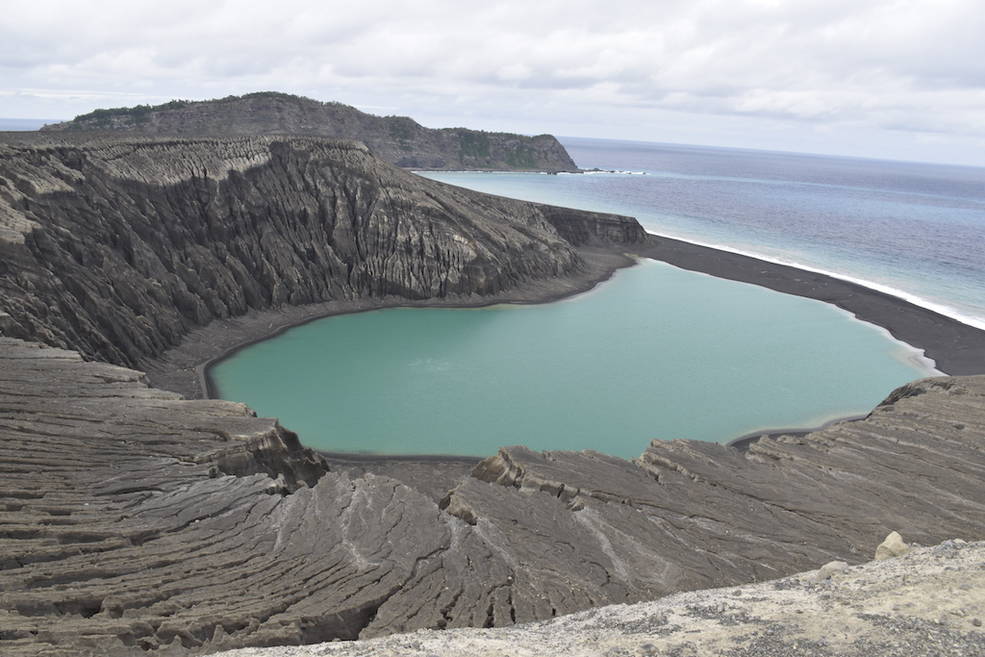
Island Made of Tuff Stuff
In late December 2014, a submarine volcano in the South Pacific Kingdom of Tonga
erupted,
sending a violent stream of steam, ash and rock into the air. The ash plumes rose as
high as 30,000 feet (9 kilometers) into the sky, diverting flights. When the ash
finally
settled in January 2015, a newborn island with a 400-foot (120-meter) summit nestled
between two older islands – visible to satellites in space.
The newly formed Tongan island, unofficially known as Hunga Tonga-Hunga Ha'apai
after
its neighbors, was initially projected to last a few months. Now it has a 6- to
30-year
lease on life, according to a new NASA study.
Hunga Tonga-Hunga Ha'apai is the first island of this type to erupt and persist in
the
modern satellite era, it gives scientists an unprecedented view from space of its
early
life and evolution. The new study offers insight into its longevity and the erosion
that
shapes new islands. Understanding these processes could also provide insights into
similar features in other parts of the solar system, including Mars.
"Volcanic islands are some of the simplest landforms to make," said first author Jim
Garvin, chief scientist of NASA's Goddard Space Flight Center in Greenbelt,
Maryland.
"Our interest is to calculate how much the 3D landscape changes over time,
particularly
its volume, which has only been measured a few times at other such islands. It's the
first step to understand erosion rates and processes and to decipher why it has
persisted longer than most people expected."
The Tongan island is the third “surtseyan” volcanic island in the last 150 years to
emerge and persist for more than a few months. Surtsey is an island that began
forming
during a similar kind of explosive, marine eruption off the coast of Iceland in
1963.